Main Menu Logo Sprite and Animation Change

Purpose

To give game designers some idea of how to change the logo in the Main Menu and edit it’s animations.

Applicability

This is applicable to Game Designer using the D6.0.1 or newer. You need a patch to get this feature, if you’re on D5.1 code.

Written Explanation

In order to simplify the process of adaptation of all the Game Titles, we created this tutorial to guide the Game Designers through the steps of changing the logos and set up the animation applied to it.

We have two types of animations:

  • Standart basic Scale Up animation – Used with only one image containing Background, Game Title and Subtitle.
  • Complete 3 step animation – Used with Background, Game Title and Subtitle in separate objects, which has a sequence of animations.

Title sprite replacement

In order to make these changes it’s required to open the “Menu” scene and drag the “UIManager 1” to the Hierarchy, which is located in Assets/_Textures/NewUI.

There is a GameLogoBackground object which is parent to the GameLogoTitle and GameLogoSubtitle. When using only one image with the whole game Title, this is the object that should be updated inside _Texture/_UI/TitleScreen.

When using the title in 3 separate sprites the GameLogoTitle and GameLogoSubtitle should be changed inside the same path and activated in the UIManager prefab and the animation.

How To Create A Patch File

Purpose

Explains how to create a .unitypackage to upgrade the code in use by production.

Applicability

This article is applicable to Developers using the D6.0.1+ code.

Video

https://youtu.be/MBKB_a8byiI

Notes

Before making a patch, I update the ‘production’ branch in git as follows:

First, I make sure the FrankenApp branch is where I want it.

Then:

git checkout production
git pull # just in case someone else has changed production
git merge --no-commit FrankenApp

By telling it not to commit, I am able to make sure that certain files don’t get changed on the branch. I would like people tracking the branch to be able to be confident that their game-specific changes aren’t going to be overwritten, and as such, I don’t want to include the following files in production:

– the level scenes
– the mission JSON files
– the dynamic variable JSON files

In short, anything that is “data”.

Likewise, I’d probably try to avoid including:
– menu scenes
– overwritten skins
– overwritten title images
Then there is dealing with conflicts — most of which happen to be from the sort of files I just mentioned, in which case, I’ll briefly look at the diff and take the version already in the production branch, so it remains unchanged.

(To grab the existing version, “git checkout –ours — FILENAME”)

A “git clean -if” might also be in order to delete stray files.


Enemy Appearances

Purpose

This article explains how to change what the enemies look like, by setting a minecraft-style skin on them.  (It does not cover how to create skins or where to obtain ones that are appropriate for our games.)

Applicability

This article is applicable to anyone wanting to change the appearance of enemies using the D5.1+ codebase.

Video

https://youtu.be/82rM4gRlkLE

Written Instructions

What Do I Need To Reskin?

The texture that is applied to an enemy is called a ‘skin’.  There are four classes of enemies (Melee, Bow, Ranged, Magic) in the D5.1 project, and they come in at five different power levels.  You need to supply 20 skins (4 classes * 5 skins each) for your enemies.  They don’t necessarily need to be unique; use your judgement.

If your game doesn’t use a class of enemies (ex. there are no “Magic” enemies in my science fiction game), then reuse textures from the other enemy types for that class.  [That way, if a Dynamic Variable is ever turned on that puts one of the unexpected enemies in your game, they’ll still look like they fit in.]

Skin Dimensions

The D5.1 codebase uses standard Minecraft skins, in the Minecraft version 1.7 and previous format.  These skins are 64 pixels wide and 32 pixels tall.  [If you find a Minecraft-1.8-style skin, which is 64×64 pixels, crop off the bottom half to make it 32×32 pixels. If you don’t have a tool you like (say, Photoshop), you might try FireAlpaca.]

Importing Skins

I suggest created a folder for your skins – say Assets/Textures/Skins/Your Game Name –and putting your texture images there.

The skins need to be imported with very specific settings, as follows:
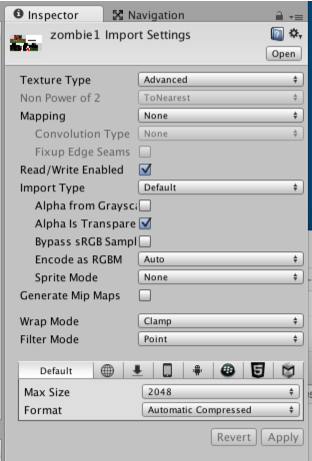
Enemy Skin Import Settings

Why these settings?

  • Texture Type = Advanced ⇒ so we can turn on Read/Write Enabled.
  • Read/Write Enabled = On ⇒ needed so that dead enemies turn into a pile of blocks using colours from the image
  • Filter Mode = Point ⇒ makes the texture show up sharp and clear (instead of blurry).
  • Generate Mip-Maps = Off ⇒ Mip maps are smaller textures used when an object is far away. This is already a tiny texture.
  • Alpha = Transparency  if the skin image has transparency in it, it’ll be transparent on the enemy.

Using The Skins

In the folder Assets/Resources/NPCFiles/NPCMaterials/BlockMaterials, you will find the following material files:

  • Magic1, Magic2, Magic3, Magic4, Magic5
  • Melee1, Melee2, … Melee5
  • Ranged1, Ranged2, … Ranged5
  • Bow1, Bow2, … Bow5

(There are also several other files there, and other materials.  I don’t think they are used and hope to remove them in the future.)

These materials are applied to your enemies.  The “Melee1” material is applied to a Tier 1 Melee enemy, and the “Bow4” material is applied to a Tear 4 Bow enemy.
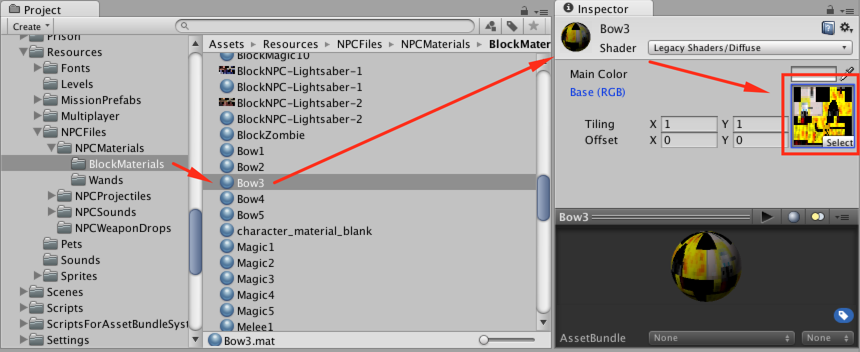
Changing A Skin

With the material displayed in the inspector, click on the ‘select’ button, and choose whichever skin you want used for that type of enemy.

 

Rescue Mission

Purpose

To explain how to create a mission in which the player has to get to a specific point to “rescue” a hostage or to defuse a bomb.

Applicability

This article is applicable to Game Designers using the D5.1+ code. We expect all types of missions in all games.

Video:


Notes:

– Don’t use copyrighted items for the bombs or for the hostage. The bomb used as an example in the video is copyrighted, so use a different one that fits with the game’s theme.
– For placing a person instead of a bomb, use the prefab named “rescue person”, located in the Assets/_AAPrefabs folder

Find Items Mission

Purpose

Explains how to create a ‘find items’ mission.

Applicability

This article is applicable to Game Designers using the D5.1+ code. We expect some of each type of mission in all games.

Video

https://youtu.be/9qZuJ2nTkhU


Kill All Of Type Mission

Purpose

Explains things you need to know specific to the ‘Kill All Enemies of Type’ mission.

Applicability

This article is applicable to Game Designers using the D5.1+ code.  We expect every game to have some ‘kill all enemies of type’ missions.


Written Explanation

In a “Kill All of Type” mission, the player has to kill all the enemies of a specific type.

The types are:

Kill All Mission Targets– Melee (someone who fights hand-to-hand or with a sword)
– Bow (someone who uses a bow and arrow)
– Ranged (someone who fights using a gun)
– Magic (someone who fights using magic)

I hope it goes without saying that there should be multiple types of enemies in the level.  Regular enemies will show up in yellow on the radar, but the special, target enemies to kill will show up in red.

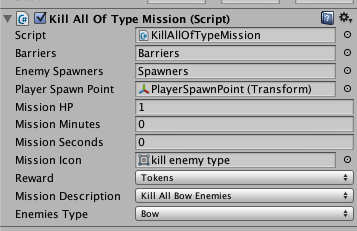
A completed ‘Kill All Of Type’ mission might look like this (although the time and HP goals need to be set).

Kill All Of Type Mission

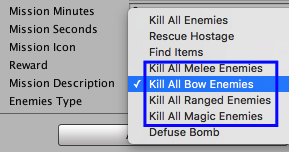
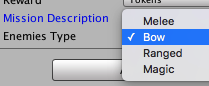
In “Enemies Type”, you set the type of enemies to kill.  Be sure to choose a matching “Mission Description”.

Kill All Mission Types

Relocation Points

Purpose

To help save you tons of time in placing spawn points in your scenes.


Applicability

This article is applicable to Game Designers using the D5.1+ code.  It is optional, but highly recommended.

Video

https://www.youtube.com/watch?v=hGcm0A74sBw


Mission System Basics

Purpose

This article explains the basics of creating missions.

Applicability

This article is applicable to Game Designers using the D5.1+ code.

Video

The video is uploading but it looks like it won’t be up for a couple of hours.  In the interim, look at the video on Dynamic Variables in Action, remember previous training you’ve had on the missions, and play with them to see if you can accomplish anything.


https://youtu.be/_OzqnxtXZgU

Notes

I recommend planning out the different sorts of missions you want to use and placing all four missions that will go in a scene at the same time.

Mission Icons are in Resources/Sprites/Missions.

Not Mentioned In Video

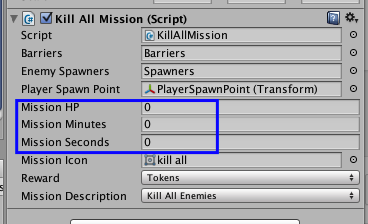
Players are rewarded for completing a mission quickly and with a certain amount of health.  You need to set the time it should take to complete the mission, and how much health they should end with to receive a checkmark.

Mission Health Setting

If you figure a player should need 45% of their health to be rewarded, set Mission HP to 45.

If you figure a mission should take 3 minutes 27 seconds to beat, set Mission Minutes to 3 and Mission Seconds to 27.


See Also

  • Baking The Nav Meshes
  • Using Relocation Points
  • Posts on specific missions

[To do — add links here.]


Using Navigation Meshes

Purpose

Shows how to ‘bake’ a navigation mesh (or ‘navmesh’ for short), why it is important, and how to make AIs follow paths.

Applicability

This step needs to be performed for every game scene by Game Designers building on the D5.1+ code.

Video

https://www.youtube.com/watch?v=oc1uxYiPoTA